Building a great product is exciting. You have an idea, you test it, you speak to customers, and little by little, the dream begins to feel real.
But there is one mistake many startup founders make.
They focus so much on the product that they forget to protect the brand behind it.
The name, logo, website domain, social media handles, product design, source code, and other brand assets may look small in the beginning. But as the business grows, these things become very important. A brand is not just what people see online. It is also the legal and commercial identity of the business.
And sometimes, a startup does not fail because the product is bad. It fails because the foundation was not protected early enough.
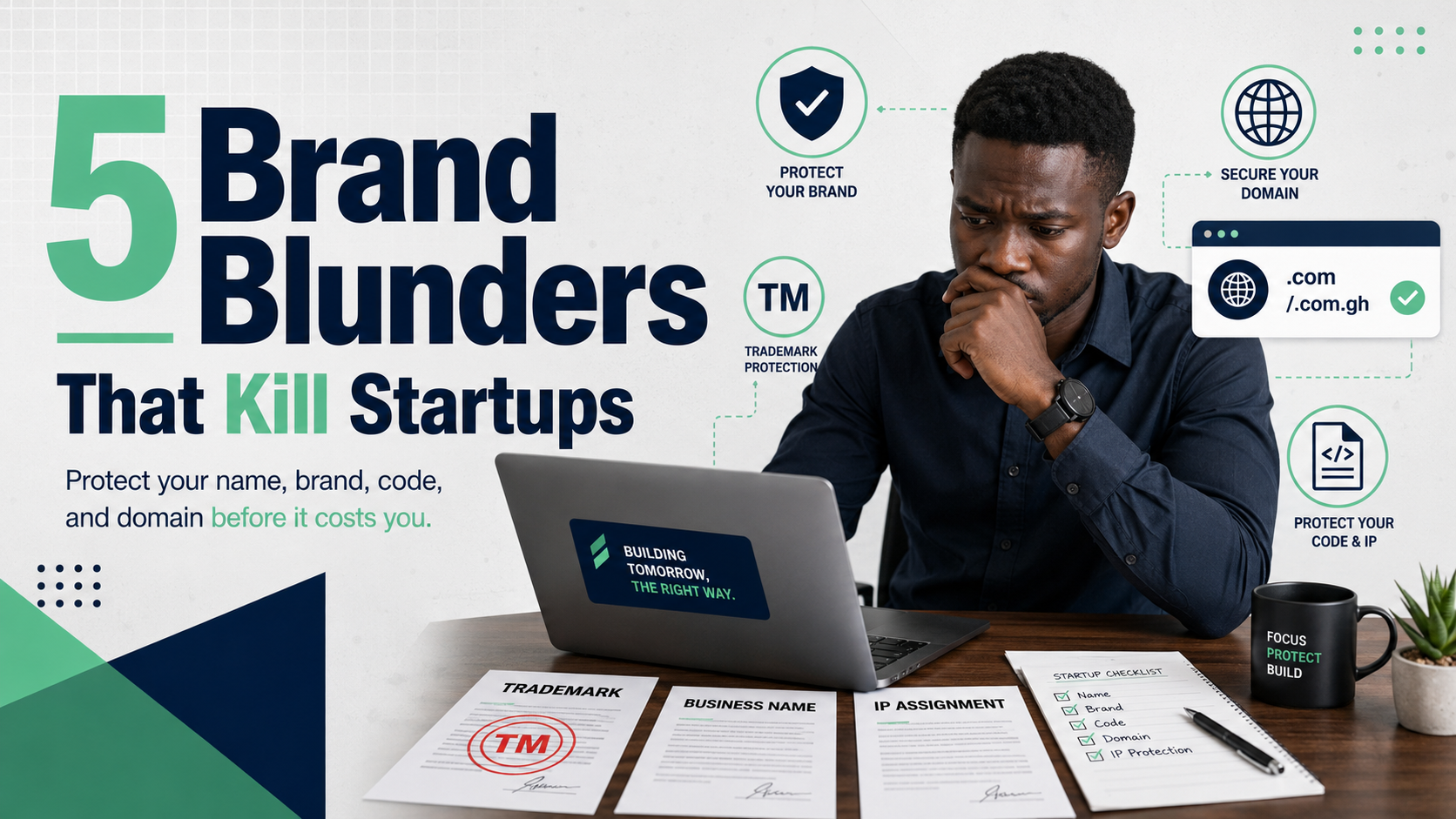
Here are five brand mistakes that can cost startups time, money, trust, and growth.
1. Launching Without Checking the Business Name
Many founders fall in love with a business name before checking whether it is available.
They design a logo. They print flyers. They create social media pages. They tell people about the brand. Some even begin selling before doing a proper name search.
Then later, they find out that another business is already using the name or has legally registered something very close to it.
That is where the stress begins.
The founder may be forced to change the name, redesign all materials, rebuild social media pages, explain the change to customers, and start the branding process all over again. For a small startup, this can drain money and energy that should have gone into growth.
Before you launch publicly, check the availability of your business name with the right registration authority. In Ghana, this means starting with the Registrar General’s Department. It is not the most glamorous part of building a business, but it can save you from a painful rebrand later.
A name may sound creative, but creativity alone does not protect ownership.
2. Thinking Social Media Handles Mean Legal Ownership
Getting the Instagram handle or X username for your brand can feel like a win. It makes the business look official. It also helps people find you easily.
But here is the truth many founders miss: social media handles are not the same as legal protection.
You can own the handle and still not legally own the brand name. Someone else may have registered the business name or filed a trademark before you. If that happens, your social media presence may not be enough to protect you.
This is why founders must not stop at digital visibility. A brand needs both online presence and legal structure.
Social media helps people discover your business. Legal registration helps protect your business.
The two are not the same.
3. Outsourcing Without Protecting Intellectual Property
Many startups work with freelance designers, developers, writers, photographers, consultants, or agencies. This is normal. In fact, outsourcing can help a young business move faster.
But there is a major risk: if the agreement is not clear, the person or agency who created the work may still have ownership rights over it.
For example, if a developer builds your MVP without an intellectual property assignment clause, there may be confusion later about who owns the code. The same can happen with logos, product designs, written content, brand manuals, photos, software, and creative assets.
This becomes a serious problem when the startup wants to raise funding, sell the product, partner with another organisation, or scale into new markets.
Investors and partners often want to know whether the startup truly owns what it claims to own. If the ownership of core assets is unclear, the business may lose opportunities.
Before outsourcing any serious work, have a written agreement. Make sure it clearly states who owns the final work, what rights are transferred, and how the work can be used.
A handshake is not enough when your business depends on the asset being created.
4. Waiting Too Long to Think About Trademark Protection
Some founders say, “We will register the trademark when we become bigger.”
That sounds reasonable, especially when money is tight. But waiting too long can be risky.
In business, the person who uses an idea first is not always the person who gets stronger legal protection. In many cases, the person who files first is in a stronger position.
This means a startup can spend years building a name, only to discover that another person or company has filed for the trademark. By then, the cost of fixing the problem may be much higher.
A trademark helps protect the name, logo, slogan, or identity that customers associate with your business. It gives the brand a stronger foundation and helps reduce the risk of confusion in the market.
Not every startup needs to file everything immediately. But every founder should at least understand when trademark protection becomes important and seek proper guidance early.
Do not wait until your brand becomes valuable before thinking about how to protect it.
5. Ignoring Domain Names
A domain name may look simple, but it is one of the most important digital assets of a business.
Imagine building a strong brand and later realising that the exact website domain has already been taken by someone else. You may be forced to use a confusing alternative, a longer name, or a domain that does not match your brand properly.
This can affect customer trust.
For example, if customers expect your website to end with .com or .com.gh but you are using something different because the main domain is unavailable, some people may become unsure whether they are dealing with the real business.
In some cases, people buy domain names early and keep them, hoping to sell them at a higher price later. This can make it expensive for a growing startup to secure the domain it should have bought earlier.
If you are serious about a brand name, check and secure the core domains early. At least protect the most important ones connected to your business identity.
Your domain is not just a website address. It is part of your brand trust.
A Simple Case Study: The Founder Who Had to Start Again
Imagine a young founder called Kofi.
Kofi builds a promising delivery app for small food vendors. He chooses a catchy name, designs a logo, opens social media pages, prints stickers, and starts onboarding vendors. Within a few months, people begin to recognise the brand.
Everything looks good.
Then, during a partnership discussion, Kofi is asked whether the business name has been properly registered and whether the app’s code belongs to the company. That is when he realises the gaps.
The name he has been using is similar to another registered business. The developer who built the first version of the app was paid, but there was no written agreement transferring ownership of the code. The .com domain is also already owned by someone else.
Suddenly, Kofi has a product people like, but the brand foundation is weak.
He now has to spend money on legal advice, rename the business, redesign the logo, change his online pages, negotiate with the developer, and rebuild customer trust.
The product did not fail.
The preparation failed.
This is the reality many founders face when they move fast without protecting the basics.
Protect the Brand Before It Becomes Expensive
Startups are already difficult to build. Founders deal with limited money, uncertain markets, product challenges, customer feedback, and competition. The last thing a founder needs is an avoidable brand problem.
The good news is that many of these mistakes can be prevented.
Before launching fully, ask yourself:
Have we checked whether the business name is available?
Do we understand the difference between social media handles and legal ownership?
Do our contracts clearly state who owns outsourced work?
Have we thought about trademark protection?
Have we secured the most important domain names?
These are not just legal questions. They are business growth questions.
A strong brand is not only about having a beautiful logo or a catchy name. It is about building something that is protected, trusted, and ready to grow.
So before you spend all your energy building the product, take time to lock down the brand.
Because building a great product does not matter if someone else legally owns your name.